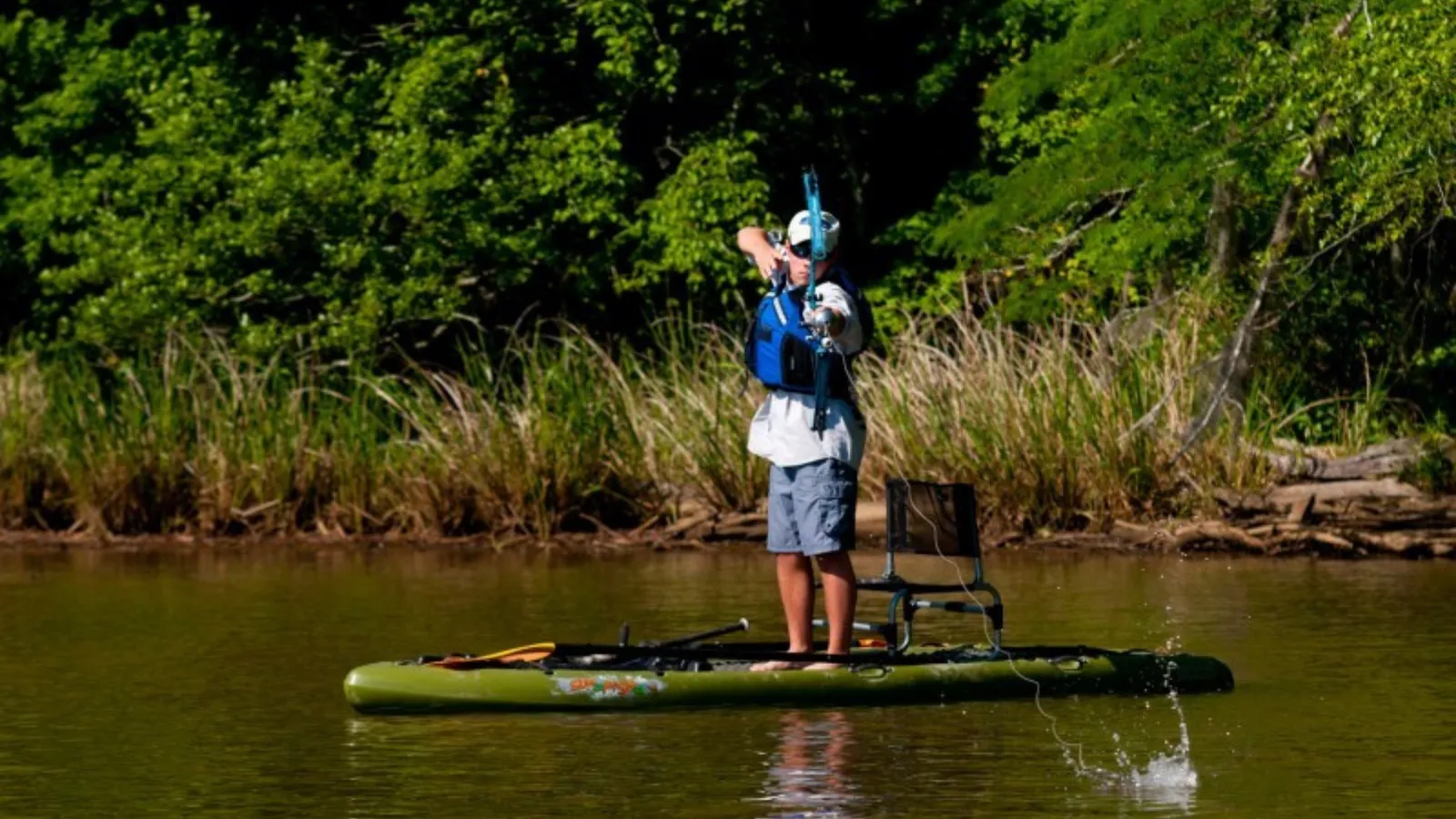
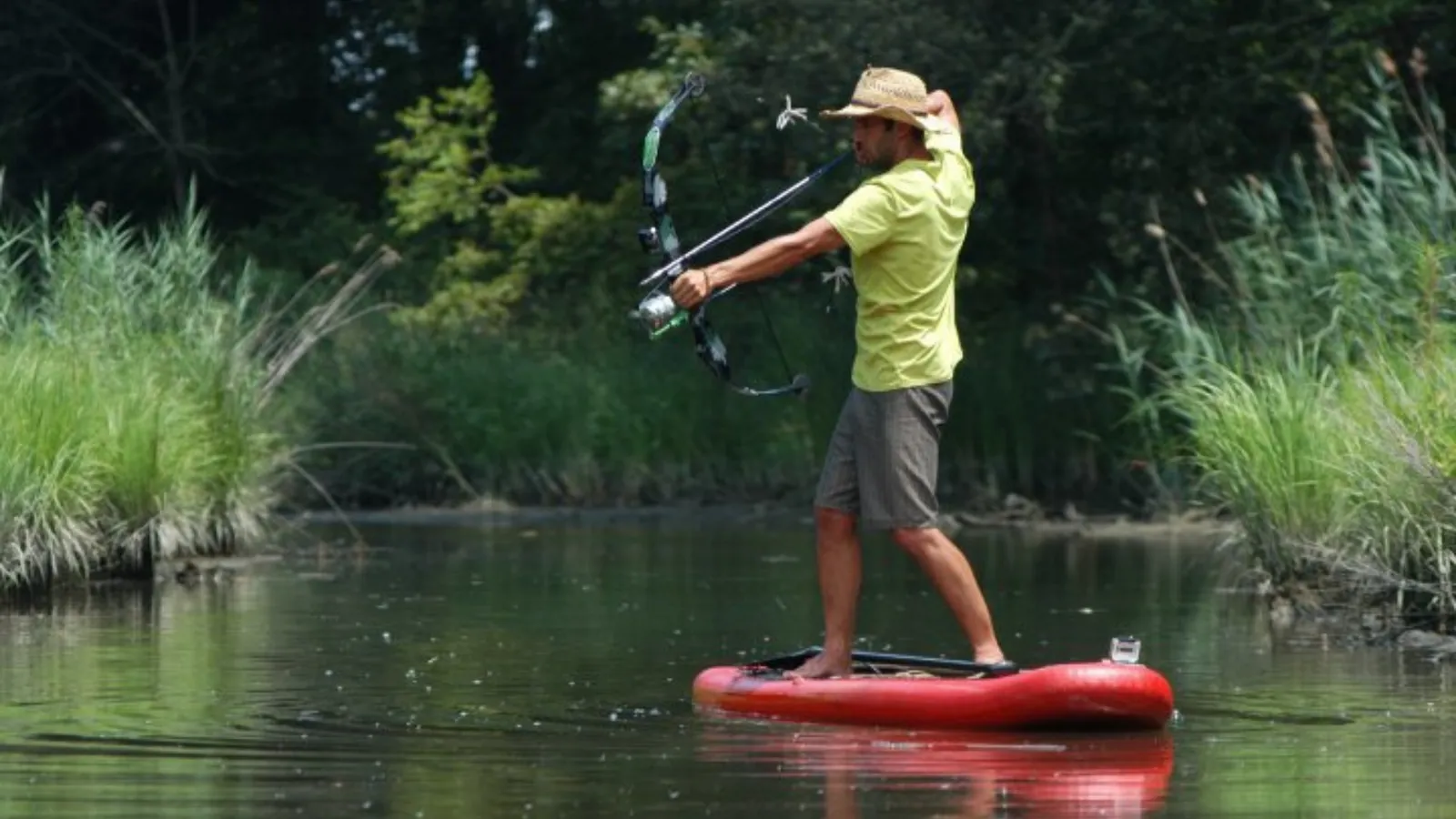
Paddle board bowfishing is hunting fish with a bow and a special arrow tied to a reel line, while standing on a stand up paddle board. You glide quietly through shallow water, spot fish near the surface, shoot, then reel the fish in by the line. Most people target rough or invasive fish such as carp and gar, because game fish are off limits to bows in most states.
Quick answer
- What you shoot: usually non-game fish like common carp, gar, buffalo and some saltwater species such as mullet or sheepshead, where state rules allow.
- What you need: a fishing license, a bowfishing bow with a reel and line, bowfishing arrows with fish points, polarized sunglasses, and a wide, stable paddle board.
- Why a SUP: it’s quiet, gets into very shallow water, and standing gives you a great view down into the water.
- The catch: you need good balance to shoot standing up, and you must check your state’s rules on species, seasons and where bows are allowed.
How paddle board bowfishing works
Bowfishing is done in shallow water, often just a few feet deep, where you can see fish near the surface. You paddle slowly and quietly, scanning for fish feeding or sunning in the shallows, along weed beds or near the bank.
When you spot one close by, you put the paddle down, pick up the bow, and shoot. The arrow is tied to a line on a reel attached to your bow. If you hit, you reel the fish in. If you miss, you reel the arrow back.
A paddle board suits this well. It’s silent, it floats in inches of water, and standing up gives you a higher view than sitting in a kayak, which makes it easier to see fish under the surface. Lots of bowfishing also happens at night with lights, when fish move into the shallows. On a SUP that means you also need a navigation light to stay legal and visible.
What fish can you shoot?
There’s no single national list. Each state decides which species can be taken with a bow, and the rules can differ even between lakes in the same state.
As a general pattern:
- Usually legal: non-game and invasive species. Texas, for example, allows bows for non-game fish such as gar, buffalo, mullet and sheepshead, but not for anything listed as a game fish or as endangered or threatened.
- Usually illegal: game fish such as bass, crappie, trout, walleye, redfish and snook. South Carolina, for instance, prohibits taking any freshwater game fish while bowfishing.
- Special limits: some species have bag limits or protection. Texas limits alligator gar to one a day, and Missouri protects alligator gar completely.
- Where you can shoot: Texas bans bowfishing in community fishing lakes of 75 acres or less and inside state parks.
Before you go, look up your state wildlife agency’s bowfishing rules, and buy the right fishing license. Plan what you’ll do with the fish, too. Many states have rules against wasting fish or dumping them.
Gear for paddle board bowfishing
The bow
Most bowfishers use a compound or recurve bow. Bowfishing kits come ready to fit a reel, and beginner guides suggest a moderate draw weight (roughly 20 to 50 lb, often around 40 lb) so you don’t tire after lots of shots. A shorter bow is easier to handle on a board.
The reel and line
The line is what lets you get your fish (and your arrow) back. There are three common types:
- Drum (hand-wrap) reels are simple and cheap, but you manage the line by hand.
- Retriever (bottle) reels let the line pay out easily and tangle less.
- Spincast-style reels retrieve quickly and have adjustable drag.
Add a safety slide, which keeps the line clear of the bowstring so the arrow can’t snap back at you.
Arrows and points
Bowfishing arrows are heavy, usually solid fiberglass, and have no feathered fletching. They have barbed fish points that hold the fish once it’s hit. Many points can be reversed to free the fish.
Polarized sunglasses
Essential. They cut glare off the water so you can see the fish.
Lights for night bowfishing
For night trips you’ll need a light to see fish and a navigation light on the board. See our best paddle board lights.
Board and accessories
- A wide, stable board. A wide fishing SUP gives you a steady platform to shoot from. See our best fishing paddle boards.
- An anchor or stake-out pole so you don’t drift while waiting. See the best paddle board anchor.
- A cooler or bin with bungees, for your catch.
- A life jacket. Pick one that doesn’t catch the bow string. Low-profile vests and inflatable belt packs work well. See the best PFD for SUP.
Tips for bowfishing from a paddle board
- Aim low. Water bends light, so fish are deeper than they look. Aim below where the fish appears. How far below depends on depth, distance and angle, so practice on a submerged target first.
- Get close. Short shots are more accurate and the arrow loses energy fast in water.
- Move slowly and quietly. Avoid banging the paddle on the board.
- Choose calm, clear water. Wind and chop make it hard to see fish and harder to balance. Early morning is often calmest.
- Widen your stance. Shoot with feet shoulder-width apart, knees soft. Shoot kneeling if you’re unsteady.
- Secure your paddle under the bungees or on a holder so it doesn’t float away when you pick up the bow.
- Keep the deck tidy. Loose line around your feet and gear on the deck are easy to trip on.
Safety
- Check your line and safety slide before every shot. Make sure the line isn’t wrapped around the bow, your wrist or anything on the deck. A tangled line can snap the arrow back toward you. Never wrap line around your hand.
- Know what’s beyond your target. Never shoot near swimmers, other boats or people on shore.
- Never dry-fire the bow (drawing and releasing without an arrow). It can damage the bow.
- Wear a life jacket and a leash. You’re standing, moving and leaning, so falls happen.
- At night, carry a light, tell someone where you’re going, and stay in areas you know.
Pros and cons of bowfishing from a SUP
Pros
- Quiet and stealthy, so you get closer to fish.
- Reaches very shallow water that boats can’t.
- Standing height makes spotting fish easier.
- Cheap and easy to transport compared with a boat.
Cons
- Shooting while standing on a board takes good balance.
- Limited space for gear and fish.
- Not much use in wind or choppy water.
- Long night trips are tiring compared with a raised platform on a boat.
FAQ
Is bowfishing from a paddle board hard?
It takes practice. Learn to paddle and balance first, then try shooting while kneeling in calm water before you stand up. A wide fishing SUP makes a big difference.
Do you need a fishing license to bowfish?
Yes, in practically every state. Bowfishing counts as fishing, so you need the right license, and you must follow that state’s species and season rules.
Can you bowfish for bass?
In most states, no. Bass and other game fish usually can’t be taken with a bow. Check your state’s rules.
Can I bowfish from an inflatable paddle board?
Yes. Many people do. Keep barbed points covered or in a quiver when not in use, so they can’t puncture the board, and be careful with arrows around the deck.
What’s the difference between bowfishing and spearfishing?
Bowfishing uses a bow and arrow on a line, usually from above the water. Spearfishing uses a spear gun or pole spear, usually underwater while snorkeling or diving. Both have their own state rules. If you like unusual ways to fish from a SUP, see what is paddle board crabbing.