Yes, paddle boarding is good exercise. It’s low-impact cardio that also works your core, back, shoulders and arms, and at a steady pace most adults burn roughly 400 to 600 calories an hour. How good a workout it is depends on how hard you paddle: a gentle float with lots of stops is closer to a walk, while steady or fast paddling counts as moderate to vigorous exercise.
Quick answer
- Cardio: yes, if you keep moving. Lab studies found paddle boarding can reach the heart-rate range fitness guidelines recommend.
- Calories: about 400–600 an hour at a general pace for most adults, less when cruising, more when pushing hard.
- Muscles: mainly core (abs and lower back), lats, shoulders and arms, with your legs working to keep balance.
- Low impact: no pounding on your joints, which suits a lot of people who can’t run.
- The catch: beginners paddling at an easy pace often don’t work hard enough to count it as cardio. It gets better as your skills improve.
How many calories does paddle boarding burn?
Using the Compendium of Physical Activities, the reference researchers use to estimate energy use, general paddle boarding works out at about 500 calories an hour for a 170 lb person. An easy paddle is closer to 300, and hard race-pace paddling can reach 850 or more.
The full breakdown by weight and effort is in how many calories does paddle boarding burn, and our calorie calculator works it out for your own weight and session length.
What the research says
Paddle boarding hasn’t been studied as much as running or cycling, but the studies there are point the same way.
It can be real cardio. Research sponsored by the American Council on Exercise (ACE) at the University of Wisconsin–La Crosse found that in the lab, beginners paddled at 77–87% of their maximum heart rate, well inside the range the American College of Sports Medicine recommends for improving fitness. They burned about 185–250 calories in 30 minutes; experienced paddlers burned 270–300.
But only if you push. On open water, the same study found beginners paddling at a leisurely pace only reached about 55% of max heart rate, below that fitness range. At a fast pace they reached about 65%, just over the line. The researchers’ conclusion: the better you get at paddling, the better the workout.
It improves fitness over weeks. A 2016 study at Bond University in Australia put 13 previously untrained adults through three one-hour paddle boarding sessions a week for six weeks. Their aerobic fitness improved by about 24%, anaerobic fitness by about 42%, and core endurance tests by roughly 20–28%.
What muscles does paddle boarding work?
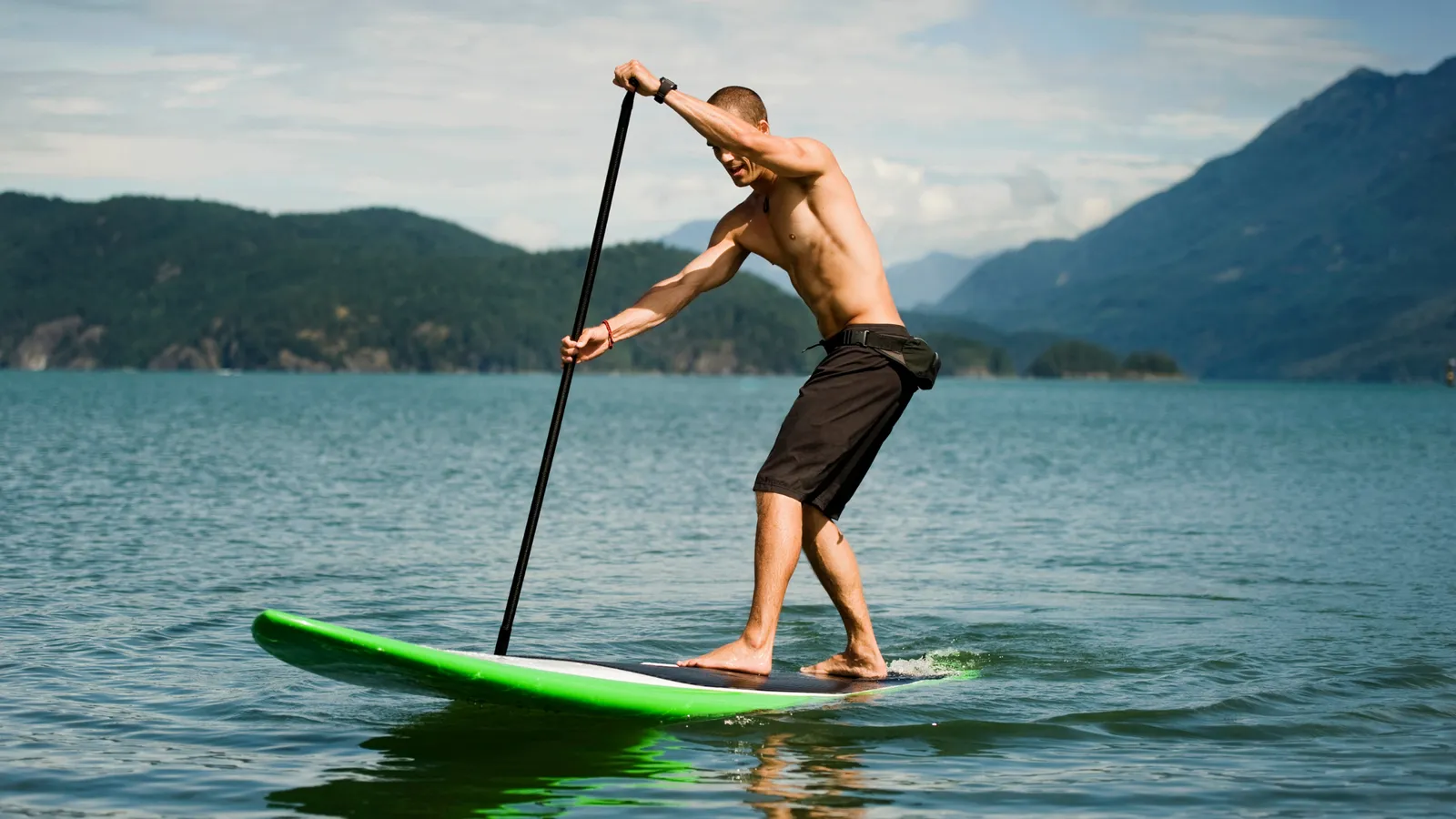
Each stroke is a pull that starts in your core, not just your arms:
- Core: the ACE research measured strong activation in the abs (rectus abdominis) and lower back (erector spinae). The obliques, which twist your torso, only kicked in hard at higher effort.
- Back and shoulders: the lats do much of the pulling, with the shoulders and upper back guiding the paddle.
- Arms: your arms steer the paddle more than they power it, if your technique is good.
- Legs and feet: they make constant small balance adjustments, though a University of Wisconsin study found they don’t work hard enough to build strength on their own.
More detail in what muscles does paddle boarding work.
Why it’s a good workout for a lot of people
- Low impact. There’s no jarring, so it’s easier on knees, hips and ankles than running.
- Easy to scale. You choose the pace. The same board works for a gentle recovery day or a hard interval session.
- Balance and stability. Standing on a moving platform trains the small stabilizing muscles you don’t use on a machine at the gym.
- It doesn’t feel like exercise. Being on the water is enjoyable, so many people paddle for longer than they’d ever spend on a rowing machine.
How to make paddle boarding a better workout
- Keep moving. Long stops drop your heart rate. If you want fitness, paddle continuously for 20–30 minutes or more.
- Use your core, not your arms. Rotate your torso through each stroke. See how to hold a paddle board paddle for good technique.
- Add intervals. Alternate one minute hard with one or two minutes easy. Or paddle hard to a buoy, cruise back, repeat.
- Paddle upwind or against the current for the first half of your trip, when you’re fresh.
- Try SUP yoga or fitness classes. Holding poses on an unstable board is a hard core workout in its own right. See what is paddle board yoga.
- Go longer. A longer, narrower touring board lets you cover distance efficiently, which makes longer sessions possible.
Whatever you do, wear your life jacket and leash, and turn back while you still have energy for the return trip.
FAQ
Is paddle boarding better exercise than walking?
At a steady pace, yes: general paddle boarding has a higher energy cost than a normal walk, and it works your upper body and core as well. A very gentle paddle with lots of stops is closer to a walk.
Can you lose weight paddle boarding?
Paddle boarding burns a useful number of calories and is easy to do for an hour or more, so it can help as part of an active lifestyle. Weight loss also depends on diet and how often you exercise.
Is paddle boarding a full-body workout?
Close to it. Your core, back, shoulders and arms do most of the work, and your legs work for balance. It’s not much of a leg-strength workout on its own, though.
How often should I paddle board to get fit?
The Bond University study used three one-hour sessions a week and saw clear fitness gains in six weeks. Any regular paddling where you keep moving and get a bit out of breath will help.
Is paddle boarding good for your back?
The ACE research found it works the lower back muscles, and many people find it gentle on their joints. If you have back pain or an injury, check with your doctor first, and start with short sessions.