You can make a paddle board at home in one of two proven ways: shape a block of EPS foam and cover it in fiberglass and epoxy, like a big surfboard, or build a hollow wooden board over a plywood “fishbone” frame, usually from a kit. Either way, expect dozens of hours of work spread over several weekends, a garage you don’t mind filling with dust, and a materials bill that won’t be much cheaper than a budget inflatable.
People build their own boards because they enjoy the project and want something unique, not to save money. If saving money is the goal, see when is the best time to buy a paddle board instead.
Quick answer
- Foam and fiberglass: shape an EPS foam blank, glass it with fiberglass cloth and epoxy resin (polyester resin dissolves EPS), fit a fin box, leash plug, vent and handle, then sand and coat.
- Hollow wood: assemble a plywood frame on a jig, add rails and a bottom and top skin of plywood or wood strips, glass it with epoxy, then fit the hardware.
- Time: dozens of hours. One builder logged about 75 hours on a Chesapeake Light Craft Kaholo 12’6” kit.
- Skills: basic woodworking or surfboard shaping, and patience with epoxy and sanding.
- Plan your size first: length, width and volume decide whether the finished board will float you.
Step 1: Decide the size before you build
The most common DIY mistake is a board that’s too small. Stability comes from width and volume, and a board has to float you plus your gear with plenty to spare.
- All-around boards for most adults are usually around 10–11 feet long and 30–33 inches wide.
- Touring boards are longer and narrower, often 12’6” or more.
- Volume (in litres) is what floats you. Each litre supports about 1 kg (2.2 lb), and a stable board needs far more than the bare minimum, especially for beginners and anyone carrying gear.
Our Board Fitter gives length, width and volume for your weight and skill level, using the same sizing rules we apply to real boards. Copy those numbers into your plans, and see what size paddle board do I need for the reasoning.
Method 1: Foam core with fiberglass and epoxy
This is how most hard boards are made in factories. It’s messy but needs fewer specialist tools than a wooden build.
Materials
- EPS foam blank (or glued-up sheets) big enough for your outline and thickness
- Fiberglass cloth (decks usually get more layers than bottoms, because that’s where you stand)
- Epoxy resin and hardener. Polyester resin melts EPS foam.
- Fin box, leash plug, vent plug and carry handle, plus spare epoxy and filler to set them in
- EVA foam deck pad
- Sandpaper in a range of grits
Tools
A hand saw or hot-wire cutter, surform or rasp, sanding blocks or an orbital sander, a router for the fin box, squeegees and brushes for laminating, and a respirator, gloves and eye protection.
Steps
- Make a template. Draw half the board’s outline on hardboard or card and cut it out. Using one half, flipped, guarantees the board is symmetrical.
- Cut the outline from the blank, leaving a little extra to shape.
- Shape the board. Shape the rocker (the curve from nose to tail), then the rails and the bottom. Go slowly and check both sides constantly.
- Laminate. Lay fiberglass cloth over the bottom, wet it out with epoxy and squeegee off the excess so there’s no dry cloth and no pools. Once it’s cured, flip and do the deck, wrapping the cloth around the rails.
- Install the hardware. Rout and set the fin box, leash plug and handle in epoxy. Add a vent plug: sealed boards build up pressure as they heat in the sun.
- Hot coat and sand. A filler coat of epoxy fills the cloth weave. Sand smooth, then add a final gloss coat if you want one.
- Fit the deck pad and fin.
Method 2: Hollow wooden board
Hollow wooden boards are beautiful and surprisingly light, but they take longer. Most first-time builders use a kit or detailed plans, which include laser-cut plywood frame parts.
How it works
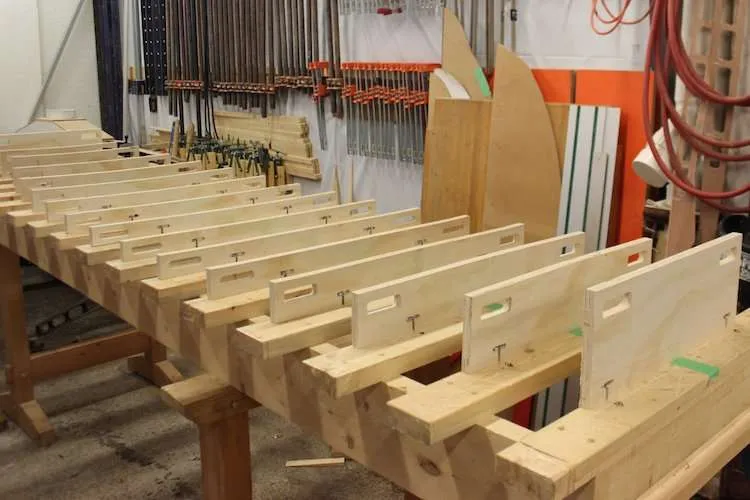
- Build a rocker table. This is a flat, rigid workbench with risers that hold the board’s bottom in the right curve while you build. It’s what makes the finished board straight and true.
- Assemble the frame. A central spine with plywood ribs (the “fishbone”) sets the shape of the board, replacing a foam core.
- Add the bottom skin and fix it to the frame.
- Build the rails. Thin wood strips, often bead-and-cove, are glued edge to edge around the frame. Thin strips bend easily; a few may need steaming around the nose and tail.
- Add solid blocking at the nose and tail and wherever hardware will go: the fin box, leash cup, handle and vent.
- Fit the deck. The top skin is glued on and held down with clamps, straps or wedges while it cures, then the rails are faired into shape with a plane and spokeshave.
- Sand, glass and coat. Like the foam board, the wood is sealed with fiberglass cloth and epoxy, then sanded and given a final coat.
Chesapeake Light Craft’s Kaholo kits, for example, use a hollow plywood hull built over a frame kit; one Kaholo 12’6” builder reported about 75 hours of work.
How long and how much?
- Time: a simple foam board might be a few long weekends; a hollow wooden board from a kit can take 75 hours or more.
- Cost: resin, cloth, foam or wood, hardware and tools add up. Unless you already own the tools, expect it to cost as much as a decent budget board, sometimes more for a wooden kit.
- Space: you need room for a 10–14 ft board plus space to walk around it, kept warm enough for epoxy to cure.
Safety
Epoxy and fiberglass dust are irritants. Wear nitrile gloves and eye protection, use a proper respirator when sanding, and work somewhere well ventilated. Follow the resin maker’s cure temperatures.
Before you paddle it
Test your board in calm, shallow water, close to shore. Check for leaks (especially in a hollow board), how it floats with your weight, and how it tracks. Wear a life jacket and leash just as you would on any board.
FAQ
Is it cheaper to make your own paddle board?
Usually not. Materials alone can approach the price of a budget board. People build boards for the satisfaction and to get exactly the board they want.
Can I make a paddle board out of plywood?
Yes. Hollow wooden boards use thin plywood for the frame and often the skins, sealed in fiberglass and epoxy. Plain plywood without glass and epoxy won’t last in the water.
Can I use polyester resin on EPS foam?
No. Polyester resin dissolves EPS foam. Use epoxy.
Do homemade paddle boards need a vent plug?
Sealed hard boards (hollow wood or EPS) are normally fitted with one. Air inside expands as the board heats up, and a vent lets the pressure equalize so the skin doesn’t delaminate.
What about building an inflatable?
Not practical at home. Inflatable boards use drop-stitch fabric and industrial bonding to hold high pressure. If you want a board you can store small, buy one; see are inflatable paddle boards worth it.